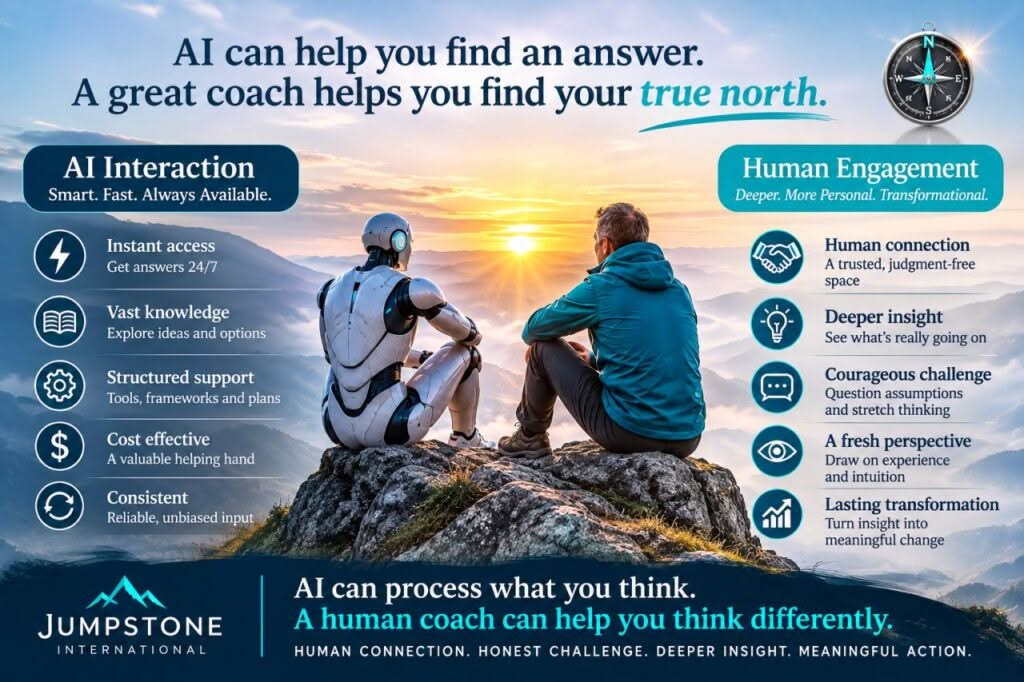
Will AI replace human coaches?
Today I asked AI…
“How close are we to creating Blade Runner style replicants?”
True bioengineered, human-equivalent beings with autonomous consciousness. Thankfully, the answer was reassuringly: we’re still a long way off!
But it got me thinking about something much closer to home. As an executive leadership coach, I used to feel threatened by AI wondering when it would eventually replace my expertise.
Yes, AI can provide answers, challenge ideas, generate insights and offer a sounding board 24/7. It’s fast, accessible and increasingly sophisticated.
But does that mean a human coach has become redundant?
I don’t think so, and here’s why…
As humans, we’re incredibly sophisticated social beings. We instinctively pick up on subtle shifts in communication, facial expressions, body language, tone, emotion and behaviour. We sense things that aren’t necessarily being said. This is where human coaching offers fundamentally valuable insights, namely:
Human Connection – Building trust and creating a safe space to be genuinely honest.
Deep Insight – Recognising what’s not being said and uncovering what’s really going on beneath the surface.
Courageous Challenge – Questioning assumptions, confronting blind spots and having the conversations others might avoid.
A Different Perspective – Drawing on lived experience, intuition and independent thinking to help you see things differently.
Lasting Transformation – Turning awareness into meaningful behavioural change, better decisions and decisive action.
Irena O’Brien, PhD provided valuable insight during yesterday’s workshop, highlighting a fundamental distinction between human coaching and AI interaction.
Human-to-human coaching involves two nervous systems interacting, whereas when using an LLM, there’s only one!
That really resonated with me because, however sophisticated AI becomes, there’s something fundamentally different about two human beings connecting, sensing, responding and engaging with one another.
Leadership isn’t just about having the right answers. It’s about understanding yourself, challenging your thinking, navigating complexity and having the courage to act. A skilled human coach can explore that deeper dynamic through an evolving relationship, observation, intuition and challenge. However, AI, used effectively, can complement the coaching experience, accelerate learning, and make reflection more accessible.
So rather than compete in asking which is best: AI or Human? It’s clear that combining forces will enhance expertise and outcomes through Human-to-Human Coaching + AI as a powerful tool.
While feeling more reassured as a human, I’m still left with two questions:
Will AI ever truly replicate the human connection at the heart of coaching?
and perhaps more importantly…
Even if it could, would you want it to?
I’d love to hear your thoughts.